

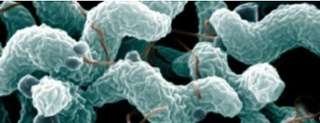
Are you involved or interested in screening for the presence of Campylobacter? Then you should be interested in a method that allows for detection of Campylobacter:
- in 30 minutes
- on-site
- with minimal sample preparation.
Campylobacter infections cause more cases of diarrhoea (Campylobacteriosis) in humans than Salmonella. The cost of Campylobacteriosis to public health systems and to lost productivity in the EU is estimated by EFSA to be around €2.4 billion a year.
Source of Infection

If you are familiar with the area, you’ll know that about 80% of Campylobacteriosis is caused by infected poultry. Raw poultry meat is often contaminated with Campylobacter, and eating undercooked chicken, or ready-to-eat foods that have been in contact with raw chicken, is the most common source of infection.
There are many Campylobacter species but Campylobacter jejuni and Campylobacter coli are the principal cause of human gastroenteritis worldwide. These two strains are better suited to colonising poultry hosts than other Campylobacters.
Screening and Control of Campylobacter Infection
Prevention of Campylobacter infection is based on control measures at all stages of the food chain, from agricultural production on a farm, to processing, manufacturing and preparation of foods, both commercially and domestically.
So How Do You Test for Campylobacter?
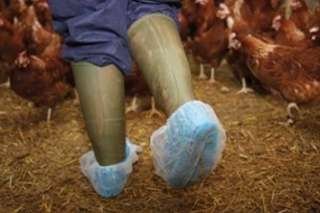
Testing chickens on a farm for both Salmonella and Campylobacter usually starts by collecting samples on boot swabs. These are fabric overshoes, worn over rubber boots while walking around the chicken house, picking-up pathogens in faeces and urine. The boot swabs are sent to a central laboratory for testing. The traditional method of analysis is classical microbiology – bacterial culturing that takes several days. More recently, molecular methods based on DNA detection have been introduced using real-time, or quantitative, PCR (qPCR). The qPCR method is much faster, taking hours instead of days. However, qPCR is still a laboratory-based method
Rapid and Simple On-Site Testing
OptiGene has developed a method of processing boot swabs to detect Campylobacter that is very fast, simple to perform and suitable for operation on-farm or at a meat processing plant. This method is as sensitive as qPCR, but faster and lower-cost, and is based on portable, easy-to-use equipment. This new system employs single temperature, or isothermal, amplification of DNA using a method known as LAMP. LAMP supports much-simpler sample preparation then qPCR and can be run on less expensive instruments. The test picks up both C.jejuni and C.coli species. This method could also be used with other sample types such as caecal and cloacal swabs or skin tissue.
OptiGene’s Method for Camplylobacter Testing
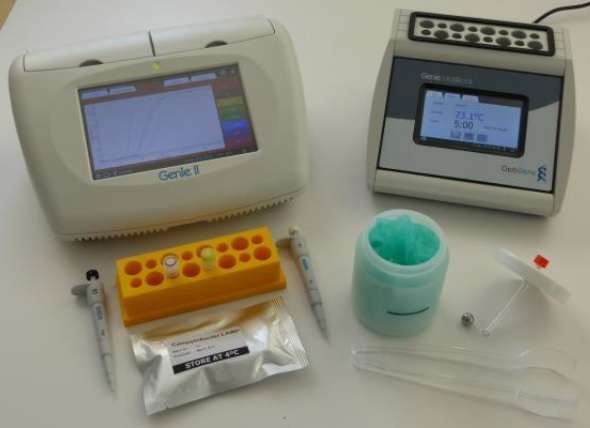
The step-by-step procedure for running this test along with a photograph of the kit is:-
- Fill plastic pot with water up to marked level
- Place boot swab in plastic pot with a ball-bearing
- Attach lid and shake pot by hand for 15 seconds
- Transfer liquid from pot to a small tube
- Incubate in Genie® HotBlock for 5 minutes
- Allow the tube to cool for 5 minutes
- Dispense liquid into a single tube in strip-of-8
- Place strip in Genie® II instrument
- Press touch screen button to start run
- Result available within 30 minutes
Watch this video (narrated by a robot?) to see the whole thing.