

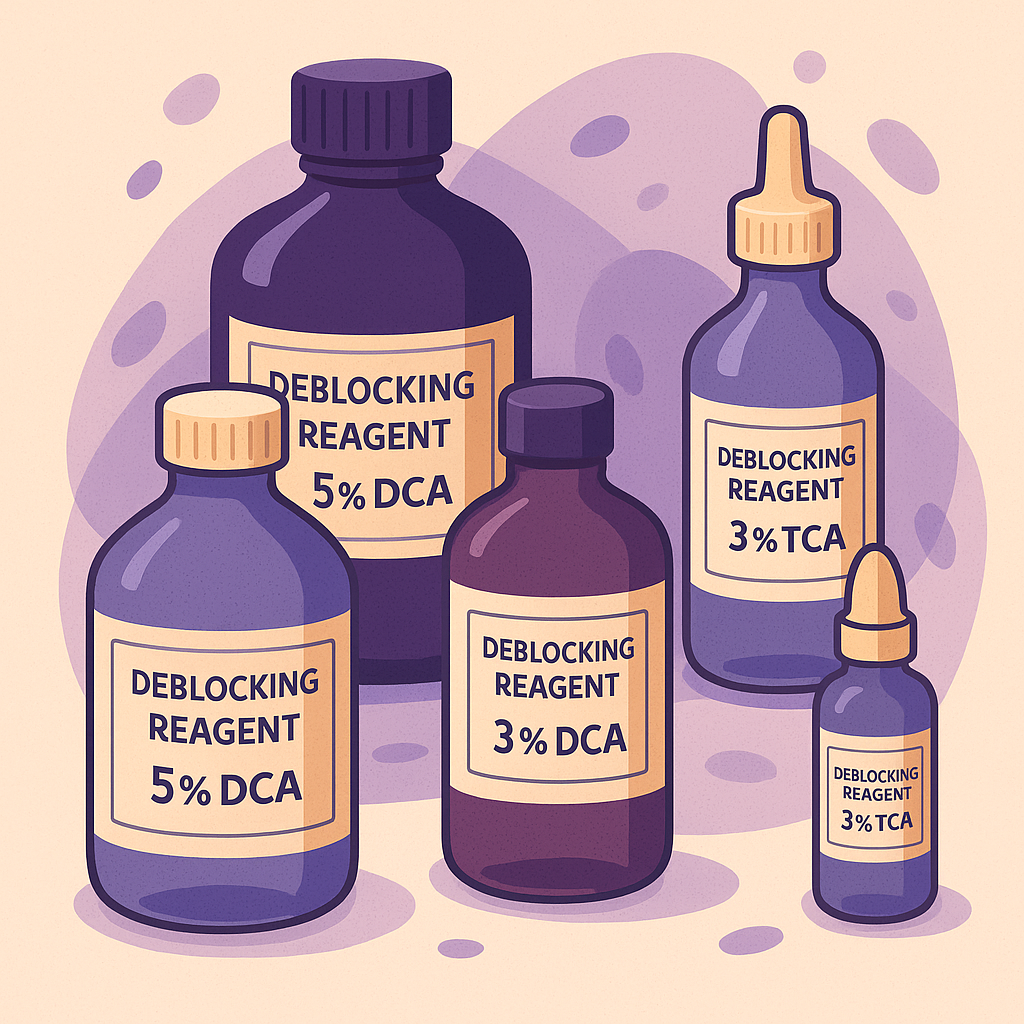
Selecting the best deblocking (detritylation) reagent is crucial for achieving high-efficiency, high-fidelity oligonucleotide synthesis. Factors such as acid type, solvent choice, concentration, and platform compatibility all influence reaction speed, control, and product quality.
At YouDoBio, we offer a variety of deblocking reagents supplied by emp Biotech designed to meet the needs of both research and production-scale workflows. Here’s a guide to help you choose the best option for your synthesis goals.
Key Factors to Consider When Choosing a Deblocking Reagent
- Acid Type: Dichloroacetic acid (DCA) vs. Trichloroacetic acid (TCA)
- Solvent System: Toluene vs. Methylene Chloride (DCM)
- Acid Concentration: 3%, 5%, or 10%
- Workflow Needs: Speed vs. gentleness vs. large-scale synthesis
- Platform Compatibility: Manual synthesis, automated synthesizers, or production-scale systems (e.g., ÄKTA OligoPilot)
Deblocking Reagent Comparison Table
| Product Name | Acid Type | Solvent | Concentration | Key Features | Best For |
|---|---|---|---|---|---|
| 10% DCA in Toluene | DCA | Toluene | 10% | Standard, fast deblocking | Routine oligo synthesis |
| 5% DCA in Toluene for ÄKTA OligoPilot 2 | DCA | Toluene | 5% | Platform-specific, larger scale | ÄKTA OligoPilot workflows |
| 3% TCA in Methylene Chloride | TCA | Methylene Chloride | 3% | Alternative deblocking chemistry | TCA-preferred workflows |
| Hyacinth 3% DCA in Toluene | DCA | Toluene | 3% | Gentle deblocking | Long oligos, sensitive bases |
| 3% DCA in Methylene Chloride | DCA | Methylene Chloride | 3% | Mild, controlled detritylation | Sensitive workflows |
Platform Recommendations
| Instrument Type | Recommended Deblocking Reagents |
|---|---|
| ABI Synthesizers | 10% DCA in Toluene, 3% DCA in Methylene Chloride |
| MerMade Systems | 10% DCA in Toluene, Hyacinth 3% DCA |
| ÄKTA OligoPilot 2 | 5% DCA in Toluene |
| High-throughput Automation | 3% DCA or 3% TCA in Methylene Chloride |
🧬 Recommendations by Synthesis Goal
- Short, routine oligos: 10% DCA in Toluene
- Long or modified oligos: Hyacinth 3% DCA in Toluene
- Large-scale or production runs: 5% DCA in Toluene (ÄKTA workflows)
- Alternative acid chemistry: 3% TCA in Methylene Chloride
- Controlled, slow deblocking: 3% DCA in Methylene Chloride
Final Tips
- Higher acid concentration = faster deblocking, but monitor for side reactions.
- Methylene chloride (DCM) = faster kinetics compared to toluene.
- For sensitive oligos, use 3% reagents for more control.
- Always validate reagent performance in your specific platform setup.
Still unsure which deblocking reagent is right for your needs? Contact us — our experts are here to help!