

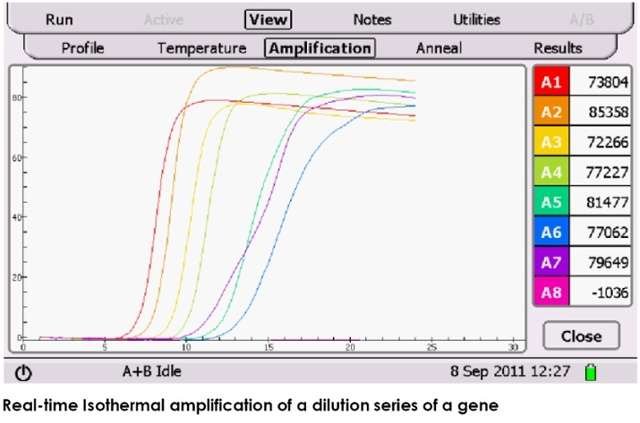
This is part 1 of a series of blog posts about the subject of loop-mediated isothermal amplification – commonly abbreviated to LAMP.
I regularly attend exhibitions with my Genie II instrument from OptiGene. At some point in the conversation, I ask if the researcher has heard of either isothermal amplification or LAMP. Certainly less than 10% of researchers, who are otherwise familiar with PCR and real-time PCR, have ever heard of either of these terms. And yet, a good number of them are doing work where LAMP would offer several benefits over either PCR or qPCR. In this article, I want to introduce LAMP to the unfamiliar and set the scene for how LAMP can be used to detect pathogens, of all types, in humans, plants and animals.
LAMP: A Young Technology
In 2000, researchers in Japan developed a novel method of DNA amplification, Loop Mediated Isothermal Amplification, or LAMP. The method is a single tube technique which offers a simple and low-cost alternative to already established amplification tools such as PCR, as well as nucleic acid sequence-based amplification (NASBA), and strand displacement amplification (SDA). LAMP is able to stand out from these other methods through the number of benefits which it brings to scientists and medical professionals. Although it is not immune to shortcomings, future directions are looking to iron out any current issues that there may be with the method.
What’s so good about LAMP?
The advantages of LAMP are numerous – and unique – giving it an edge when compared with alternative methods for amplifying target nucleic acids. To begin with, it can be conducted without the demand for expensive thermocylers, as are required for PCR, because LAMP is an isothermal process. So, none of that ramping up and down of temperatures you see with regular PCR. Secondly, the process allows for simple and easy selection of genes as it produces cauliflower-like stem-loop structures of DNA which make for a more rapid selection process.
In addition the LAMP process is easy to perform, though if you look at the video above, it looks a bit weird! It requires four primers, plus a strand-displacing DNA polymerase and an instrument that can maintain a constant temperature, e.g. a standard laboratory water bath, or a portable battery-powered isothermal PCR instrument. The process doesn’t face the issue suffered by alternative nucleic acid amplification methods of background interference, due to the fact that LAMP is highly specific for the target sequence. These features make it particularly suitable as the basis for a point-of-sample, or in-the-field molecular testing system.
Further to this, LAMP is also able to efficiently amplify RNA sequences through combination with reverse transcription. It also turns out that LAMP is more resistant than PCR to inhibitors present in complex samples such as blood.
Finally, the advantages of LAMP, such as its ease of use and low cost set up, have opened a several avenues for development of assays to a number of diseases. To give a small taste, LAMP has been shown to be effective in detecting TB, malaria, and sleeping sickness, as well as detection of other common pathogens such as Plasmopara viticola, S. mansoni, Brucella spp, Eimeria, salmonella and early HIV-I diagnosis.
The bottom line is that LAMP is low-cost, rapid, highly selective and sensitive process. Due to these advantages the method allows scientists to carry out DNA amplification in different settings and for different purposes, for which alternative methods of DNA amplification are unsuited to.
Are there any drawbacks?
Nobody’s perfect. The LAMP process does have some limitations, but these are mainly due to the lack of familiarity of the method, deriving from the widespread use of PCR and qPCR. The design of LAMP assays can also be daunting to beginners. A nice review can be found here (PDF document). There are also challenges to using LAMP for multiplex assays in a single sample and in quantitation of target DNA.
What’s in store?
The benefits of LAMP are opening new avenues for development of applications including point-of-care testing and genetic testing in the developing world where resources are scarce. In the coming years we will see LAMP being developed for use in testing of many more diseases and infections, specifically those which are prevalent in developing nations. Further to this, researchers are also currently working on developing the LAMP process in order to rapidly and efficiently run tests on food products and environmental samples. In order to deliver these applications we may see researchers developing the LAMP methodology to be combined with Lab-on-a-chip technologies. This system would see use both in developed and developing countries.
In addition to the development of the LAMP process to test for a wider number of pathogens, we will also see research focused on making the LAMP test process even simpler, thus hopefully tackling the limitations that the process currently faces.
Move over PCR, here comes LAMP
Due to its simple, rugged, and low cost methodology, LAMP is quickly becoming the preferred method of DNA amplification, in fact the journal of Molecular Ecology Resources stated in a paper published this year “move over PCR, here comes LAMP”. It has many advantages over more established methods, such as PCR, which allow LAMP to be used in a more diverse range of settings. This has opened up LAMP to a number of research avenues focussed on developing assays for numerous diseases and infections, which may be endemic in developing nations where PCR testing may not be a viable option. Finally, LAMP will be used to test not only for human pathogens, but plant and animal pathogens too.