

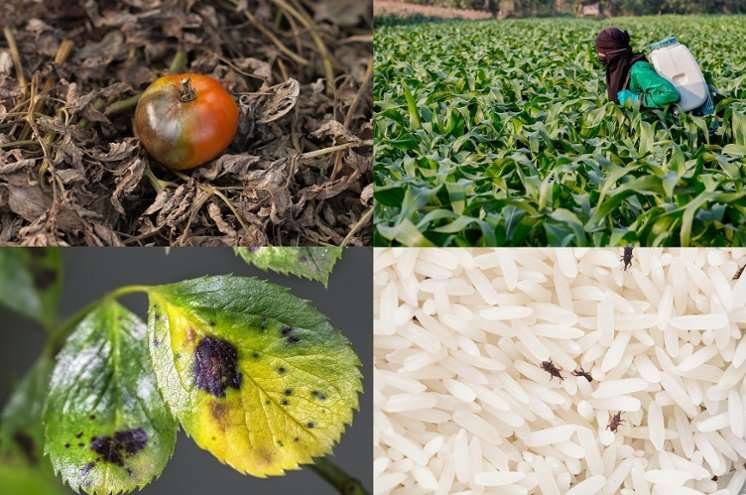
Why do we care about plant pathogens?
Plant pathogens pose more than a threat to the health of flora. Humans have an interest in the spread of plant pathogens for two reasons. Firstly because of their impact on farming, and secondly (and related to the first reason) is because of the impact of pathogens on the human population.
With the global human population growing exponentially, the issue of producing enough food to sustain life is paramount. The use of farmland for crops has been shown to feed more people, per square metre of land used, than land used for farming animals. Therefore, successful crop harvests are a fundamental part of feeding an expanding human population, especially in areas where food is scarce and poverty is rife. Disease due to pathogens has been proven to be fatal to agriculture, with 42% of the production of the 6 most important food crops being lost to disease. Globally, disease accounts the loss of between 20% to 40% of all crops.
Plant pathogens have negative commercial consequences in addition to the human cost. Commercial crop markets have an increased demand for the quality of crops available for food. Damaged crops sell for less. There is also a cost associated with the use of pesticides. In many cases, early detection of pathogens – at the molecular level, where there is no visible disease or damage – can save on costs associated with crop maintenance.
Closely related to the impact of plant pathogens on the farming industry is their knock-on impact on the wellbeing of people. Plant disease negatively impacts people in two ways, by causing crop devastation which leads to famine, and by causing disease. Historically, plant pathogens have been responsible for widespread famine, for example the potato famine of the 1800’s which effected much of Europe. In addition to this, on a number of occasions scientists have been able to attribute plant disease as the underlying cause of a number of human afflictions. For example, between 1990 and 1991 an increased incidence of anencephaly and spina bifida in newborns in the area close to the Texas-Mexican border was linked with the mycotoxins present in the wheat tortillas being consumed by the mothers.
Current research into LAMP assays for plant pathogens
Before giving an overview of LAMP assays for plant pathogens, I want to be clear that the term “plant pathogens” covers bacteria, fungi, viruses and insects that can affect the amount and quality of crops produced. This short overview, as well the featured videos below, should give an idea of the enormous capability of LAMP to help in the prevention and control of plant disease.
Plasmopara viticola is a pathogen which causes grape downy mildew. This disease causes as much as an 80% reduction in vineyard yields, making it one of the most important grape diseases that needs to be tackled worldwide. Up until now, grape downy mildew has restricted the development of the entire grape industry. However, researchers have now been able to develop a quick, simple and accurate method of Plasmopara viticola using LAMP.
Boxwood Blight was first reported in the 90’s in the UK. Since then the disease has spread to the US and Canada. In the US alone the commercial sale of boxwood is estimated to bring in around $103 million each year, demonstrated the size of the damage that widespread disease could cause. This is why the LAMP assay developed to detect Boxwood Blight pathogens last year is so important.
Video of OptiGene’s Genie II Portable LAMP Instrument for detection of Ash Dieback (Hymenoscyphus fraxineus)
LAMP assays have also been developed for detection of pathogens such as Fusarium oxysporum, which causes devastating Fusarium wilt in chickpeas, Sclerotinia sclerotiorum, which causes disease in a range of plants, Botrytis cinerea, which causes grey mould disease, Fusarium graminearum, which causes head blight in wheat and barley, and many more.
Future directions
With the increasing pressure on agriculture to produce greater crop yields to feed a growing global population, the importance of detecting devastating pathogens has never been greater. Experts predict that the world’s population will grow by around 2.3 billion between from 2009 to 2050 – an increase of around a third. Crop production will have to rise in order to produce enough food for the world’s population. In fact it is estimated that it will be required to double by 2050. While there are still some areas of the planet where farming could potentially expand, such as sub-saharan Africa, the emphasis is on getting more from the crop yields that we already have. Therefore, we can expert to see plant pathogen detection becoming more of a focus than it already is, and we can expect LAMP processes to be at the centre of this.
Final takeaway
Controlling the spread of plant pathogens is becoming increasingly important. Not only because plant disease can cause human disease in some cases, but mostly because the world’s population is growing and crop yields need to increase in order to produce enough food to support this. LAMP is at the centre of development techniques for detecting a number of plant pathogens, it stands out from alternative processes because it is cheap, fast, and accurate.