

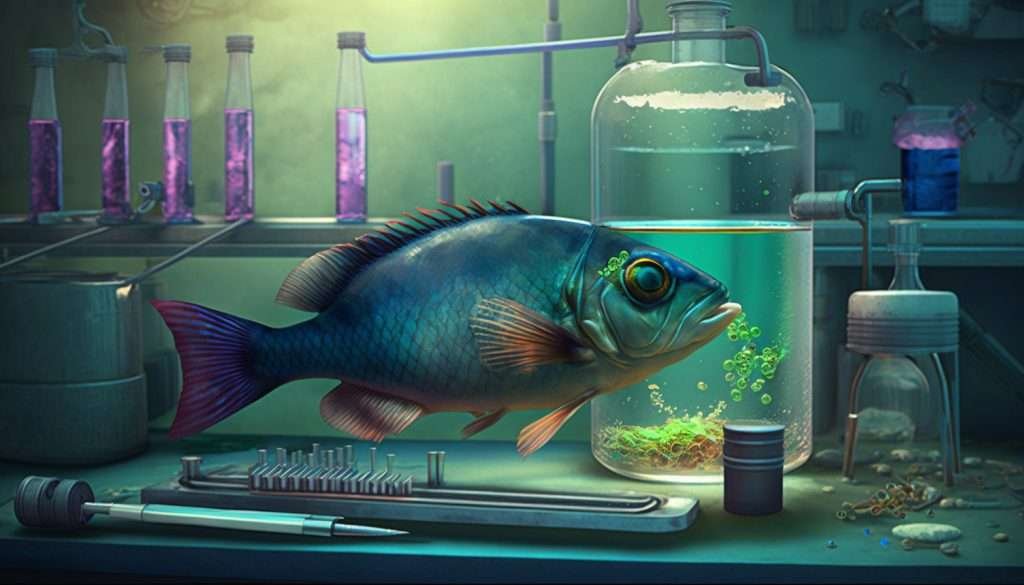
Did you know that the fish we consume as food is only half in weight of what is actually caught? The rest is discarded in the name of processing. That is a huge waste of a precious resource. Particularly today, when we have the technology and know-how to extract valuable biomolecules from fish waste that have utilization in their own right in pharmaceutical, cosmetic and agricultural industries. In fact, many experts refrain from calling the discarded fish byproducts as waste, emphasizing the fact that through proper extraction techniques, this discarded portion itself can yield true and profitable products.
Harvesting valuable by-products from fish waste requires specialized purifying techniques. Chromatography is one of the most important methods employed by bio-processing and purification plants. The term is universally applied to any method that is used to ‘separate’ components of a mixture. High-performance liquid chromatography and thin-exchange chromatography are used in particular to extract useful components from organic waste.
As consumer demand for convenience increases, the food processing sector continues to thrive and grow. But this comes at a cost: excessive waste generation. This is particularly true of the fish processing industry. Over the last five decades, fisheries and aquaculture production industries have grown eightfold.1
Before hitting the market, it is estimated that about 20 million tons of fish waste is discarded each year, representing at least 25% of the yearly marine fish catch.2 This immense amount of fish waste is increasingly becoming a global concern, both for economic and environmental reasons. Chromatography offers a ready solution in this regard.
Table of Contents
Profitable Biomolecules in Fish Waste
Profitable biomolecules in “waste” from the fish processing industry
Fish Waste
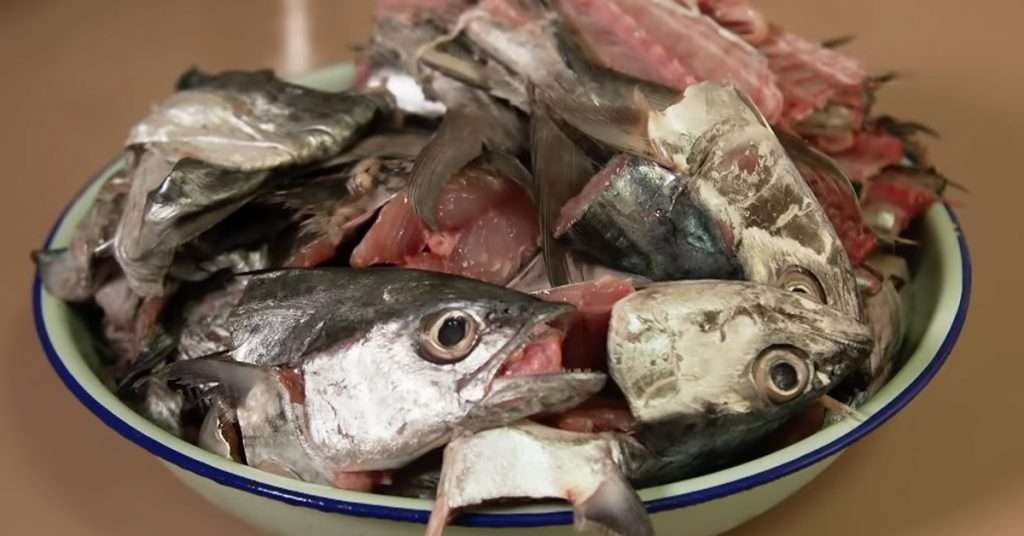
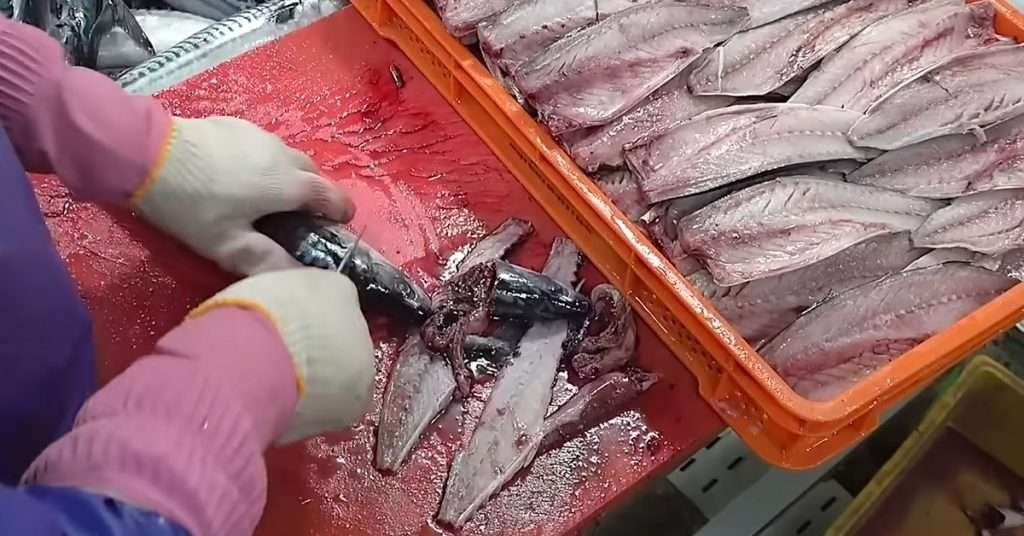
Fish processing plants employ several steps to convert fresh catch into products that are fit for consumption. At the minimum, before packaging, these steps include scaling, beheading, gutting, cutting of fins, filleting and bone separation.
Such processes end up producing fish waste that constitutes almost 50% in weight of the original catch.3 This waste in fact is a treasure trove hiding some valuable and profitable gems in terms of various biomolecules that can be salvaged from its different components:
Fish scales and skin:
Fish scales and skin are some of the richest biologic sources of two key proteins: collagen and gelatin, both of which have extensive application in the pharmaceutical, cosmetic and food industries. At least 70% of fish skin is made up of them. Gelatin is popularly used for jellies and candies, and also forms the coating for pills and capsules.
Collagen has been used for tissue engineering and as part of surgical dressings. These proteins may also be derived from bovine and porcine sources. However, these latter sources often come with ethical or religious barriers, and marine sources represent a useful, economical and sustainable alternative.
Fish bones
Fish bones and frames, which are largely eliminated during the filleting process, contain valuable organic and inorganic compounds. Collagen and gelatin are the main organic products and account for about 30% of the bone weight.
The remaining 70% largely consists of hydroxyapatite, a complex compound containing calcium and phosphorous. Hydroxyapatite has several biomedical applications. It is used to treat small bony defects, where it serves as a scaffolding material to support bone regeneration. Hydroxyapatite may also be processed further to elemental calcium, which is used for dietary supplementation.
Fish viscera:
Fish viscera are the source of one of the most popular derivatives of fish waste: fish oil. Fish oil is a rich source of omega-3 fatty acids, which are known for their cholesterol-lowering and antioxidant properties.
Until recently, fish oil was obtained from dedicated fishing processes. However, due to concerns over sustainability, focus is turning towards producing fish oil from processing waste. This once again highlights how purifying fish waste can be a lucrative business.
Crustacean and squid waste:
Crustaceans, or shellfish, such as lobsters, shrimps and crabs tend to generate more waste than regular fish. A large part of the waste comes from the shells, which can constitute up to 60% of the total weight. Crustacean waste is a good source of the following:2,4
- Chitin: α-Chitin is derived from shellfish such as shrimp or crab waste. Chitosan is an important biomedical compound that is derived from chitin by deacetylation. It has antioxidant properties and is extremely biocompatible, allowing it to be used in wound dressings and skin ointments. It is also used in cosmetic products and the food industry.
- Astaxanthin: This is a pinkish-orange compound that is derived from the organic part of the shell. Astaxanthin is a carotenoid, closely related to β-carotene, and is believed to have antioxidant, anti-cancer, anti-inflammatory and anti-diabetic effects. It has been used as a nutritional supplement and as a food-coloring agent.
- Squid skin, pens and viscera: Squid skin is another important source of collagen. Squid pens, or the internalized shells, contain up to 38% β-chitin. Viscera are important sources of lipids and fish oil.
- Squid ink and melanin: Squid ink is a dark fluid produced by the squid as a defense mechanism. The ink by itself has many applications. It is primarily used for its flavor as a food additive in Japanese and Mediterranean cuisines. In addition, it has various health benefits owing to its antioxidant and anti-microbial properties. In-vitro and animal studies have shown that squid ink can protect against high blood pressure, heal stomach ulcers and boost immunity in general. A major component of squid ink is melanin, which blocks ultraviolet radiation and has antioxidant properties. Melanin can be used for sun-protective films and sunglasses and as part of anti-aging treatments.5
Enzymes from seafood processing waste
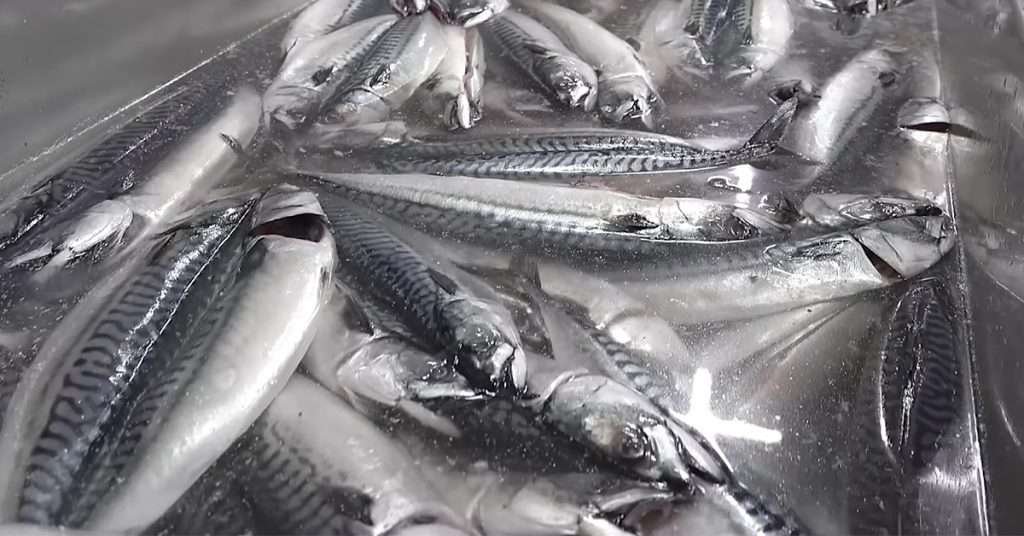
Seafood waste is a rich source of enzymes that have significant commercial value. According to an estimate, enzymes, such as carbohydrases, proteases and lipases, were valued at up to US $2.3 billion by 2018 in the global food and beverage additive market.6
The following table lists some key enzymes available from fish waste:6
| Enzyme Group | Examples | Sources |
| Proteases | Pepsin, gastricin, trypsin, alkaline proteinase, acidic protease, calpain, cathepsins, chymotrypsin, collagenases, elastase, rennin, alkaline peptidase | Sardine, salmon, cod, tuna, trout, carp, mackerel, ray fish, shrimp, freshwater prawn, herring, capelin, squid |
| Carbohydrases | Chitinases, amylase, galactosidase | Fish and shellfish, sea cucumber, tilapia |
| Other enzymes | Lipases, transglutaminases, hyaluronidase, alkaline phosphatase, urease, nucleotidase, xanthine oxidase | Shrimp shell, lobster, stonefish |
Fish waste products have significant pharmaceutical and biotechnological applications. Fish protein hydrolysates, for instance, have the potential to become the ‘natural’ alternative to drugs that are currently used to treat hypertension and cancer. Hydrolysates, however, require more extensive processing than other compounds that would be time and resource intensive. Despite the multitude of applications described above, fishery by-products are still extremely underutilized.
Chromatography Solution
So how do we extract what’s useful from fish waste—chromatography offers a solution
In the fish waste industry, there is an ongoing search for the ideal chromatographic method that is resource-efficient and cost-effective. Some of the issues identified with traditional chromatographic techniques are generation of high temperatures, which may degrade useful target biomolecules, use of toxic solvents, which can not only leak into the environment but also remain in traces in the final product, and the high costs associated with processing.
To overcome these challenges, experts have sought more efficient and environment-friendly ‘green methods’ of extraction.7 Some of the methods that have been identified are outlined below:
Supercritical fluid extraction
It uses carbon dioxide as the solvent eliminating the need for toxic solvents. However, it is associated with high power consumption and can be used only for selected substances. For example, polar compounds cannot be extracted using this technique.
Microwave-assisted extraction
The solvent is warmed in a microwave, which reduces its consumption and increases its penetrating capacity. However, the process consumes a lot of power and may be difficult to scale up.
Ultrasound-assisted extraction
Ultrasound helps increase the penetrating capacity of the solvent. This is especially useful with cellular material as it increases the release of cellular content. However, it again consumes a lot of power.
Enzymatic hydrolysis
This technique relies on proteolytic enzymes instead of organic solvents. While the overall process is more efficient, it can be expensive and difficult to scale up.
As research is underway to increase the efficiency of chromatography procedures and cut costs, some experts feel that the focus should be shifted to other aspects of the bioprocessing workflow. While it may not be possible to further optimize upstream processing techniques, as they are entirely dependent on the type of waste, improving downstream processes can markedly scale the efficiency of the overall process.
SMART Chromatography for fish waste purification
SMART Chromatography—an efficient, cost-effective and scalable technology for fish waste purification
One of the main drawbacks of standard chromatography techniques is the time taken to complete the entire extraction and purification process. A large portion of this time is devoted to preparation of the raw material through a process called clarification. Clarification comprises two steps: the first involves the separation of solids and liquids via techniques such as centrifugation, sedimentation or filtration. The next step is concentration through evaporation, ultrafiltration, adsorption or precipitation.
What if it were possible to completely eliminate clarification as a step in the workflow? Although this would be ground-breaking in terms of time and costs saved, it has never been considered a real option because the standard chromatography column is not designed to accept particulate matter. That’s where SMART Chromatography comes in because it does just that.
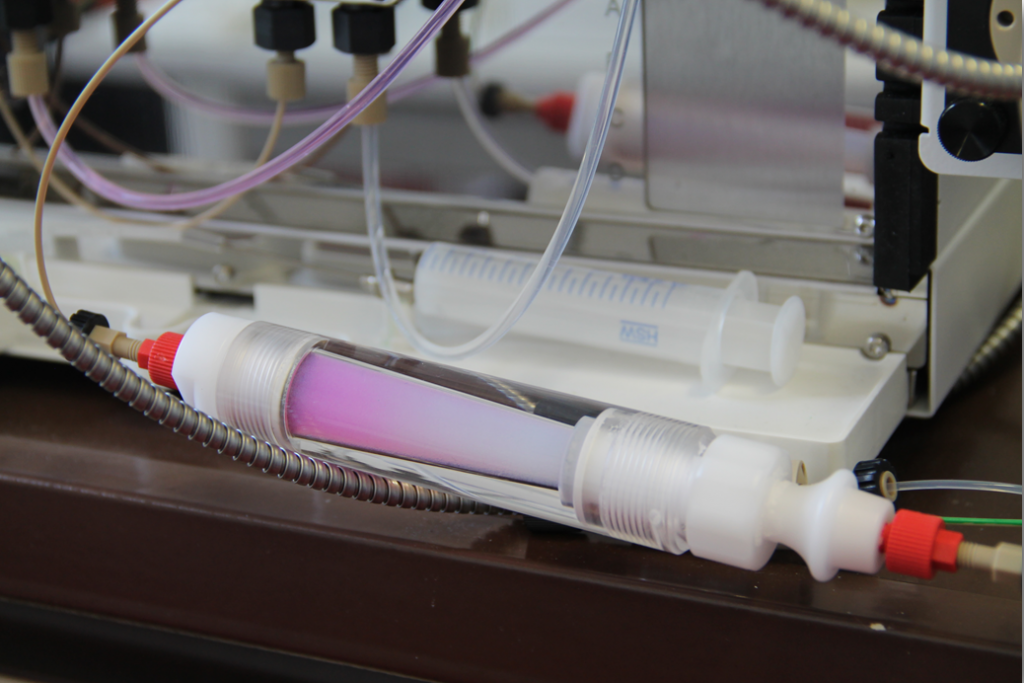
With SMART Chromatography, the extract from upstream processing can be loaded directly to the purification column, eliminating the need for clarification. The key differentiators of this technology are:
- It works on particulate matter, so clarification/solid-liquid separation is not needed.
- It uses radial rather than vertical flow, making it a more efficient, low-pressure system that is linearly scalable.
Combined, these technological refinements yield some major advantages:
- Decreased processing time—from days to just hours.
- Reduced costs—procedural and consumable costs associated with the clarification step are eliminated.
- More product recovery—not many bio-manufacturers are aware that a significant amount of product loss (about 5% to 60%) occurs at the clarification stage. In contrast, with SMART Chromatography, up to 98% of the product can be recovered.
- Rapidly scalable—SMART Chromatography columns are designed to be linearly scalable. This ensures a quick and reliable transition from R&D to production at scale.
For a detailed review of how this innovative technology works, check this article. The bottom line: when it comes to extracting profitable biomolecules from fish waste, SMART Chromatography seems to be the ideal solution.
SMART Chromatography is a product of EMP Biotech. We represent EMP Biotech in Denmark, Sweden and Norway. You can contact us here. We would be happy to discuss how we can assist you in implementing SMART Chromatography to turn fish waste into profit!
REFERENCES
- Shavandi A, Hou Y, Carne A, McConnell M, Bekhit AEA. Marine Waste Utilization as a Source of Functional and Health Compounds. Adv Food Nutr Res. 2019;87:187-254. doi:10.1016/bs.afnr.2018.08.001
- Caruso G. Fishery wastes and by-products: A resource to be valorised. J. Fish. Sci. 2015;9:80-3.
- Caruso G, Floris R, Serangeli C, Di Paola L. Fishery Wastes as a Yet Undiscovered Treasure from the Sea: Biomolecules Sources, Extraction Methods and Valorization. Marine Drugs. 2020 Dec;18(12):622.
- Wang CH, Doan CT, Nguyen AD, Wang SL. Reclamation of Fishery Processing Waste: A Mini-Review. Molecules. 2019;24(12):2234. Published 2019 Jun 14. doi:10.3390/molecules24122234
- Tran-Ly AN, Reyes C, Schwarze FW, Ribera J. Microbial production of melanin and its various applications. World Journal of Microbiology and Biotechnology. 2020 Nov;36(11):1-9.
- Menon, V. (2016). Enzymes from Seafood Processing Waste and Their Applications in Seafood Processing. 10.1016/bs.afnr.2016.06.004.
- Ivanovs K, Blumberga D. Extraction of fish oil using green extraction methods: A short review. Energy Procedia. 2017 Sep 1;128:477-83.